The Ways People and Physicists Think About Time
Friday, September 12, 2025
This Saturday at The Science Circle
The Ways People and Physicists Think About Time
Friday, April 12, 2024
This Saturday at The Science Circle
Friday, March 19, 2021
Announcement: This Saturday at The Science Circle - "Understanding Science: Particle Physics"
Saturday March 20
10AM to 11 AM SL time
Only a century ago, while the concept of an irreducible object known as an atom was long known and there was growing evidence for its existence, most people had little idea that atom were composed of even smaller particles, many of them with exotic characteristics.
In the next few decades, electrons, protons, and neutrons, the relatively stable particles that make up the atoms that constitute all matter were discovered, followed by particles only found in natural events involving high energy. As more powerful particle accelerators were developed, still more exotic particles were theorized and discovered and a Standard Model of how particles interacted and were related was formed in the 1960’s-1970’s.
What does the Standard Model reveal about the particles that make up everything? How can Feynman diagrams show particle interactions? What is missing from the Standard Model? Join me as we explore the search for the smallest of things – subatomic particles – and what we have learned about them.
Presentation by Dr. Phil Youngblood
For more information, Click Here.
http://maps.secondlife.com/secondlife/The%20Science%20Circle/67/129/32
Friday, March 13, 2020
Announcement: This Saturday at The Science Circle - "Physics And Arts"
10 AM to 11 AM SL time
By Professor Giuseppe Longo
The talk will try to demonstrate, with many examples, that science and arts are much more entangled than what is commonly understood. Not only because arts make use of the most recent technological developments to create new forms of expressions, but also at a much deeper level. Both Sciences and Arts are in fact different ways to systematise and organize the perception of the world and therefore reflect what in a given epoch can be called the “cultural paradigm”. Every time deep changes take place in this paradigm, equally deep changes take place in both Arts and Sciences. In some cases arts anticipates science and in others science anticipate Arts.
To read more, Click Here.
https://maps.secondlife.com/secondlife/The%20Science%20Circle/114/206/30 (Auditorium)
Friday, February 21, 2020
Announcement: This Saturday at The Science Circle - "Celestial Orbits, Part I"
"Celestial Orbits, Part I"
Saturday, February 22nd
at 10AM PST
Here I present the basic physics that underpins the orbits of celestial bodies. Starting from Newton’s laws of motion and gravitation, and using many examples from everyday life, I elucidate fundamental concepts of mass and weight, true and fictitious forces, potential and kinetic energy, and orbital trajectories. This lays the groundwork for future talk(s) on celestial orbits.
Presented by William Wall / Syzygy Asymptote
For more information, Click Here.
https://maps.secondlife.com/secondlife/The%20Science%20Circle/67/129/32
Friday, August 31, 2018
Announcement: This Week At The Science Circle: "Sterile Neutrinos"
“Sterile Neutrinos: a new particle not known to our Standard Model?”
Saturday September 1
10 AM - 11 AM PDT
By Rob Knop
"Over the last year, sterile neutrinos have been in the news. There is some suggestion that evidence for them is present in experimental data, but it’s still very uncertain. If they’re real, it would be very exciting for particle physics, which has the interesting conundrum of a model that is *too good* — in that it’s been decades since there has been any real surprises in particle physics. A new and unknown particle would mean that we’re finally venturing into deeper explorations of the fundamental nature of high-energy physics; it could potentially have cosmological implications as well. In this talk, I’ll give a summary of the Standard Model of Particle Physics, and describe how amazingly (and, indeed, disappointingly) successful it’s been in predicting and explaining the results of particle physics experiments. I will describe what neutrinos are, and how regular neutrinos differ from sterile neutrinos. Finally, I’ll talk about the possibilities that we’ve seen sterile neutrinos, and what the implications are."
More information about Knop's presentation at https://www.sciencecircle.org/event/sterile-neutrinos-a-new-particle-not-known-to-our-standard-model/
The Science Circle (61/126/32)
Friday, October 13, 2017
Announcement: This Week at the Science Circle
Saturday the 14th, 10 AM PDT
“Gravitational Waves: The 2017 Nobel Prize in Physics”
Presented by Rob Knop Ph. D, USA
More information about Knop's presentation, including Abstract and Location, at
https://sciencecircle.org/upcoming-saturday/
The Science Circle (61/126/32)
Saturday, August 5, 2017
Emilin Nakamori’s Physical Machines (2008)
Sansar has certainly put the spotlight on what's new from Linden Lab. But what about what people could do with Second Life in the past? In late summer 2008, I met up again with a girl I had met at the SL5B: Emilin Nakamori. She was a builder who made machines with moving parts geared to work with Second Life physics. Interested in how far she she could push the limits, she began to make really big machines.
Read the September 2008 article in the SL Newspaper Archives.
Saturday, April 23, 2016
"Furry Tower" at Luskwood
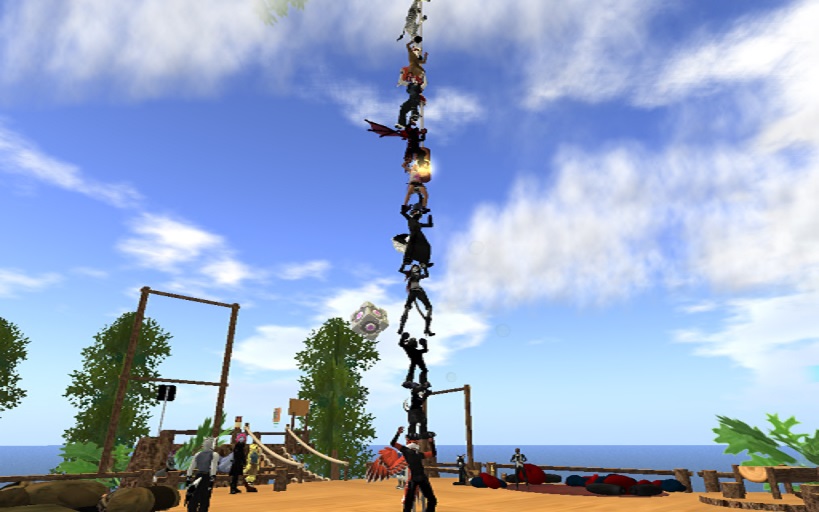
From March 1, 2008. It used to be in Second Life that avatars could "stack" on top of one another. And at Luskwood on occasion we'd try making a "furry tower." This one was eleven avatars high. I've heard stories of towers as high as two dozen people high before someone crashed or had to leave. But eventually the physics of Second Life were modified so avatars could no longer stack on one another so easily, and the "furry tower" activities became a whimsical memory of Luskwood's past.
Wednesday, January 22, 2014
Science Discussion Tonight at the Exploratorium
5 PM slt tonight Jan 22 - Jennifer Ouellette talks with Dave Goldberg about "Ask a Physicist" & "The Universe in the Rear View Mirror."
Join the studio audience at: Exploratorium (147/52/26).
Listen live or later at http://www.blogtalkradio.com/virtually-speaking-science/2014/01/23/jennifer-ouellette-dave-goldberg .
Monday, September 24, 2012
A Look at Linden Lab's "Patterns"
Rod Humble admitted Minecraft was an influence, "So the notion was you take a very simple 3D Creation tool you take that lovely elegance of the resources that's in Minecraft, and them make the whole thing have physics from the ground up." In both, one has an avatar in a world gathering up resources. But in Minecraft the avatar builds tools which it can use. It doesn't in Patterns. Nor are there monsters and hot lava to make survival a question. The world itself is different, alien looking compared to the familiar grass, trees, and hills. And instead of cubes, the world is made up of triangular tiles, as is the avatar.
What can one do with the triangular tiles? They can be used to create three dimensional blocks. And these blocks can be used to build larger structures. The tiles can come from a variety of materials, wood, stone, clay, etc. And the hardness and weight of the cubes can have an effect on what one can build. Physics and gravity matter here much more than Minecraft. If one keeps extending a horizontal column of blocks, it will eventually break and fall. And a mostly stone column with a clay base will break sooner than a clay column with a stone one.
When working with the world, sometimes the physics acted in ways that surprised the Linden team. The Lindens are hoping to get users on board to continue to see what can be done with the place, as Humble stated in the video trailer from Linden Lab, he wanted "creators in from the earliest possible moment." A few days after the IGN article was published, Linden Lab began taking pre-orders for the game's "Genesis version" for $9.95. The page stated those buying would be "entitled to have your name featured in the credits of the game in version 1.0."
Hamlet Au commented that in giving an advance peek to IGN, it looked like Linden Lab was aiming at gamers rather than users of Second Life as more likely to give Patterns a try. He also states he managed to get in touch with Minecraft's creator Markus Persson. Of Patterns, he thought, "Looks great."
Once again, Patterns Genesis can be pre-ordered at: http://buildpatterns.com/buy/.
Sources: IGN, New World Notes
Bixyl Shuftan